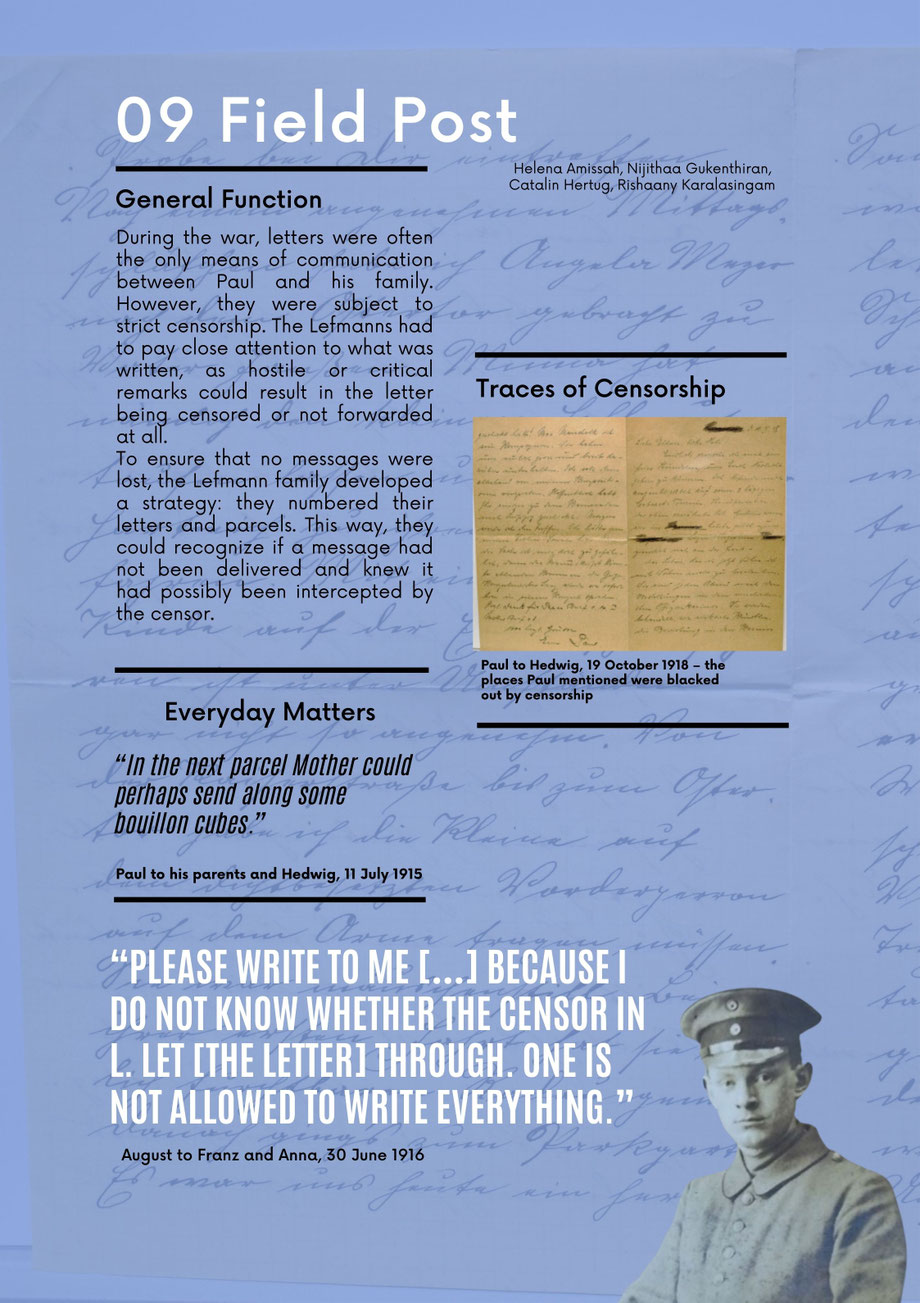
Transcription of the letter from Paul to the Lefmann family on 11 July 1915:
“France, 11 July 1915
Dear Parents, dear Heti!
Today, Sunday, I once again have the chance to write to you in more detail. Yesterday evening I went to bed already at 8 o’clock and slept straight through until this morning at 7. Our new quarters are on the ground floor and have the advantage that we always have fresh air. Our old quarters, a hayloft, had only two roof windows without panes and the door as air supply, and the door was so small that one could scarcely enter. I had the “privilege” of sleeping right under a roof window, and one night when it poured I did not wake up until I was soaking wet. Now we have straw sacks and woolen blankets, whereas before we slept on straw and had to cover ourselves with our coats.
Yesterday we went swimming and I was able on that occasion to put on clean laundry. I have my laundry washed here by an old French aunt. For shirt, trousers, and socks I paid 55 pfennigs last time; and I was also able to use my French, since I had to make myself understood with the woman, when it would be ready and how much it would cost. I have now enough laundry, also towels and soap, so you need not send any more. My friend Becker, who is a carpenter, made me a shelf, and I can put all my things in order. Besides I also still have the rucksack, which serves for keeping the more important things.
This morning at 7:15 was pay roll call. I have enough money and do not spend much, since you send me everything I need. Yesterday evening for the first time in a long while I drank a glass of beer. One can only allow oneself that if one does not have to go out in the night to trench work, otherwise one cannot keep awake for weariness. One is not used to beer drinking anymore and becomes quite limp from it. Beer can be had here in abundance, and whoever wants to get drunk may have that pleasure every evening. I pass it up splendidly and prefer to sleep.
This Sunday will again be quite torn apart, for at 1 o’clock we must march to Menneville, where the articles of war were again read to us. By the time we are back here it is 3:30, and at 5 o’clock there is church service, which will last until 6, and at 7 parade and mail call. Then it is already again nearly time to go to sleep. In one way it is good, that one never really comes to full awareness.
Today I sent off a carton with letters to you. They are almost all your letters, which I am sending back. First, the parcels we may send off from here may weigh only half a pound, and secondly it makes no sense to keep everything.
Jürgens has now also gone into the hospital. I am very sorry for the poor fellow; he has quite worn himself out. We now have a new doctor, who proceeds very harshly. Yesterday one of our comrades reported sick, as he is severely lung-diseased and coughs all night, so that he can neither live nor die. The doctor examined him and declared him fit for field service at the front; he also reproached him for not having volunteered already. What do you think of that? Another collapses every night while working and has heart cramps. That man is neither discharged nor sent to hospital. The mentally ill one, who slept in my quarters, has finally been sent to hospital. Every night the fellow wandered around armed with his electric torch. It was downright uncanny. He was under the delusion that he was to be shot here. Sick men there are among us every day. At any moment one falls down. I think I am here one of the most able and bear the service very well. Should they once more muster us and pick out those fit for field service, then I will surely be among them. But of such a muster there is of course no question, at least not for the present—you need not worry.
The food is still just as miserable as at the beginning. I now always throw some bouillon cubes into the soup, then it is at least somewhat edible. In the next parcel Mother may perhaps send some bouillon cubes again. We go out every night now. One gets fairly used to the service. For 14 days now I have been out every night except Sunday. My hands have not yet suffered too badly from it. The skin, though, peels off and the hands become hard inside.
Your parcels have all arrived so far. I should repeat once again: two parcels weekly are enough. My condition is now again good. I am not the only one who has felt poorly. Nearly all comrades suffer from it. Today it is this one, tomorrow that one. It all comes only from the food. My appetite leaves much to be desired. I never have hunger. When I eat, I do it under compulsion. Only breakfast after the work at 7 o’clock in the morning tastes good to me. I think I have already lost several pounds; but I have gained a much healthier color and generally feel quite well.
Do you remember the tall comrade who stood with us in Hamburg on the barracks yard? You should see how that fellow eats. Our food bowls have exactly the form of a washbasin. Such a washbasin he empties twice every noon. It takes him about an hour to finish. He is 2.10 meters tall and in civilian life a porter. By him I would not want to be thrown out into the street, for he has tremendous strength. His only physical defect is his feet; otherwise he is sound. When he has walked the way to the work place, he cannot take another step further. At times he lags half an hour behind, because he cannot walk. At woodcutting he carries away alone a tree that otherwise four men struggle with, and makes the cheekiest jokes. He is the original of our company.
The day before yesterday, when we were out, I had to fetch water from the neighboring village, and on the occasion looked at the completely shot-up place. I also went into the church, which is entirely destroyed, and found the remains of a hymn book. I send it along. I also found a booklet of song texts, which I will send on another occasion. Both things are fine souvenirs. You will of course keep them.
How are my pupils, by the way? Which has Papa kept? From Lotte Braun I received a little parcel of sweets a few days ago.
Enough for today!
With warmest greetings,
Your Paul.”
Transcription of the letter from August Meyer to the Lefmanns on 30 June 1916:
“August Meyer to Anna and Franz
30.6.16.
Dear Anna, dear Franz!
It is already half past 8 in the evening, nevertheless I want to use the little time still at my disposal to answer your dear lines, which gave me such joy. (I will write to Minna tomorrow.) This evening my joy is especially great, for I received no less than 4 parcels, one packet of newspapers and 3 letters. Two parcels were from Minna and from J. P. Jacobsen, which you, dear Franz, had still arranged; I will, as soon as I have time, thank him, but please in the meantime thank him orally for me. Furthermore I received a parcel from Brunssen, containing a small bottle of wine. Brunssen is truly a splendid person, he has already so often delighted me in this way.
The general war situation has, in my opinion, entered a critical stage. The French are urging the English to attack, a sign that things are not going so well for the former, and that Verdun is now markedly threatened. The English seem to have followed this pressure, for at Arras they attack heavily on our front. Nine divisions strong, they are said to have attacked at Arras, but to have been bloodily repulsed. Since Sunday one hears a cannonade and drumfire such as I have never heard. One cannot imagine such a thing. Whoever has to endure it will surely go mad. Last night and all day today again much signaling was done. Whoever had to get up at night could see how the sky in the west and northwest was fiery red and lit by searchlights. Today especially the heavy calibers thundered. We will probably have a hard stand, for the English will have assembled a mass of troops and furnished themselves well with munitions. I think they will attempt a breakthrough, to give the French relief. Hopefully they will not succeed. If the matter becomes precarious, we too will be alarmed, that is certain. So let us wish it does not come so far. After all, we are still here. But the poor soldiers! How many have once more bitten the dust. One would think the other belligerent nations should at last come to reason and stop this dreadful bloodshed. But who will make the beginning? We too must in the end yield something. I believe that in military terms no decision can be brought about, for otherwise the war could still last a year. Something quite extraordinary must occur. What that might be I do not know. It concerns the economic side of the struggle, and in this respect the French are as badly off as we are; the English pursue a policy of protraction in this matter. In any case we all have had more than enough.
Please write me whether you have received this letter, for I do not know whether the censor in L. [Laon?] has let it through. One cannot write everything, otherwise I would strike still other chords.
I am enormously pleased that you take such care of Angela and Helmut, for which I thank you warmly. It must also surely be a great joy for you, when the two of them bustle about on your farm.
I could scribble so many other things, but time presses.
A thousand greetings (also to Heti from Altenesch)
from your August.”
